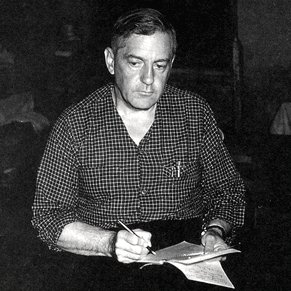
R. Gordon Wasson
Dates: 1898–1986 Domain: Ethnomycology, History of Religions, Classical Studies
Biography
Robert Gordon Wasson was born in Great Barrington, Massachusetts, in 1898, and spent most of his adult life as a banker — eventually rising to become Vice President of J. P. Morgan. His intellectual life ran on a parallel track: an amateur interest in mushrooms that began with his wife Valentina Pavlovna, a Russian physician who had grown up in a culture where wild mushrooms were both culturally important and treated with great sophistication. Their collaboration produced the first serious study of the cultural attitudes toward mushrooms — Mushrooms, Russia and History (1957), a two-volume limited edition that documented the astonishing variety of human responses to fungi across cultures and that opened the door to what Wasson eventually called ethnomycology.
The turning point was his participation in a Mazatec mushroom ceremony in Huautla de Jiménez, Mexico, in 1955, conducted by the curandera María Sabina — the first documented case of a Westerner participating in this ancient ritual. Wasson described the experience as the most significant of his life: a direct encounter with divine reality of a kind he had not previously believed possible. His 1957 Life magazine article, "Seeking the Magic Mushroom," brought the existence of psilocybin mushroom ceremonies to wide public attention — and, by extension, brought Timothy Leary and the psychedelic revolution one of its central inspirations.
Wasson's scholarly contribution was to apply the same ethnomycological methodology to ancient texts. His Soma: Divine Mushroom of Immortality (1968) argued that the Vedic god-substance Soma, which plays a central role in the Rigveda and whose identity had been unknown for millennia, was the fly agaric mushroom (Amanita muscaria). This argument, which mobilized extensive evidence from the Rigvedic texts and from comparative botany and ethnography, transformed Vedic studies and remains contested.
The argument most directly relevant to the project came in 1978, with The Road to Eleusis, co-authored with Albert Hofmann (the Swiss chemist who had discovered LSD in 1943) and Carl Ruck (a Harvard classicist). The thesis was as follows: the sacred drink (kykeon) consumed by initiates at Eleusis contained psychoactive compounds derived from ergot (Claviceps purpurea), a fungus that parasitizes barley and whose alkaloids are the chemical relatives of LSD. The ancient initiates were not experiencing ordinary consciousness during the revelation; they were experiencing an entheogenic vision induced by a carefully prepared psychoactive preparation. This is why the Eleusinian experience was so uniformly described as transformative, why the initiates reported genuine encounters with the divine, and why the tradition could claim that those who had been to Eleusis were different from those who had not.
The hypothesis is contested. Classical scholars have raised objections about the toxicology of ergot-contaminated barley, about the feasibility of controlled preparation of psychoactive ergot compounds in antiquity, and about the consistency of the hypothesis with the literary evidence. The discovery of ergot residues in ritual vessels at a site near Eleusis in a 2020 study added new evidence on the side of the hypothesis. The project's position is to present the hypothesis clearly, note the evidence for and against, and engage seriously with what the hypothesis implies regardless of its ultimate truth: that the initiatory experience may have involved a deliberately induced altered state of consciousness, and that the ancient world may have understood this not as a chemical trick but as a genuine technology for accessing a dimension of reality not normally visible.
Key Works (in library)
| Work | Year | Relevance |
|---|---|---|
| The Road to Eleusis (with Hofmann and Ruck) | 1978 | The entheogenic hypothesis for the Eleusinian Mysteries |
| Soma: Divine Mushroom of Immortality | 1968 | The identification of the Vedic Soma as Amanita muscaria; ethnomycological methodology applied to ancient texts |
| Persephone's Quest | 1986 | The late synthesis; entheogens as the origin of religious experience generally |
Role in the Project
Wasson's hypothesis forces a question the project cannot avoid: what were the initiates at Eleusis actually experiencing, and what was producing that experience? If the answer involves psychoactive compounds, this does not reduce the experience to "mere" chemistry — the project insists that the question of what mediates an experience is distinct from the question of what the experience discloses. A pharmacological mechanism does not settle the ontological question. But Wasson's argument does refocus attention on the phenomenology of the initiatory experience itself, and on the ancient world's sophisticated deployment of specific substances, times, and ritual contexts to reliably produce experiences of a specific kind. This is the ancient equivalent of what Corbin calls the methodological preparation of the organ of knowledge — and its implications are considerable.
Key Ideas
- Entheogenic Hypothesis: The claim that the ancient Mysteries employed psychoactive substances as a deliberate technology for producing the visionary experience that constituted initiation.
- Ethnomycology: The study of the human relationship with fungi across cultures — the discipline Wasson effectively founded through his combined banking intelligence and scholarly passion.
- The Kykeon: The barley-water-mint preparation consumed at Eleusis; the central element of the initiatory rite whose psychoactive properties Wasson, Hofmann, and Ruck proposed to identify.
- The Entheogen Concept: Wasson (with Ruck and others) coined the term entheogen ("generating the divine within") to replace "psychedelic" — a term that carried too much 1960s cultural baggage and too little precision.
- The Amateur Scholar's Contribution: Wasson's career exemplifies the possibility of major scholarly contributions from outside the academy — driven by personal experience and disciplined curiosity rather than professional incentive.
Connections
- Influenced by: María Sabina and the Mazatec tradition (direct initiatic experience), Albert Hofmann (chemical analysis), FIG-0008 Burkert (scholarly engagement), FIG-0056 Kerényi (Eleusis scholarship)
- Influenced: The entheogenic approach to the history of religions, the contemporary psychedelic research revival, the work of Carl Ruck, Brian Muraresku (The Immortality Key)
- In tension with: FIG-0008 Burkert (who took the entheogenic hypothesis seriously but remained cautious), classical scholars skeptical of the evidence, those who read the Mysteries as purely symbolic
Agent Research Notes
[AGENT: perplexity | DATE: 2026-03-22] Wasson's dates are confirmed 1898–1986. The Road to Eleusis was published by Harcourt Brace Jovanovich (1978); a 30th anniversary edition with new material was published in 2008. The 2020 study reporting ergot residues at a site linked to Eleusis is: Gonzalez Celdrán et al., "Psychoactive plant preparations at a Hellenistic-era sanctuary," Nature Scientific Reports (2020). Brian Muraresku's The Immortality Key (2020) is the most thorough recent treatment of the entheogenic hypothesis, extending it beyond Eleusis to Christian origins. Wasson's Life magazine article "Seeking the Magic Mushroom" appeared May 13, 1957.