Arcanum XIX — Le Soleil (The Sun)
Definition
After the Moon's reflected light and its distortions, the Sun arrives. Direct illumination. No intermediary, no reflecting surface, no symbolic encoding requiring decipherment. The Sun shows things as they are. Arcanum XIX addresses gnosis (CON-0009) in its fullest sense — not knowledge about something but the knowledge that comes from seeing directly. The way the eye knows light not by reading about it but by opening.
Tomberg (LIB-0084) and Mebes (LIB-0053) both treat the Sun as the Arcanum of achieved clarity. Where the Moon illuminated a landscape of ambiguity, the Sun dissolves ambiguity by sheer presence. Problems that seemed intractable under moonlight turn out to have been products of the distortion itself. The Sun does not argue. It reveals. And what it reveals includes the seer — whoever stands in sunlight is also illuminated, visible to others and to oneself.
Two figures beneath the Sun introduce a dimension absent from the preceding Arcana: relationship. The Moon was solitary navigation. The Sun is shared perception. The tradition reads these figures as friends — not lovers, not master and disciple, but equals who see the same light and confirm each other's seeing. Friendship here is not a social convenience but an epistemological condition. Direct knowledge, fully achieved, is inherently communicable. Inherently shared.
Tomberg's Reading (Letter XIX)
Tomberg's Letter XIX develops the Sun as the Moon's counterpart and correction (LIB-0084). His central argument: the difference between reflected and direct knowledge is not a difference of degree but of kind. Moonlight shows the same objects as sunlight — flattened, desaturated, ambiguous. The transition from Moon to Sun is not brighter light. It is a different source. What the mind knows through inference, interpretation, and symbolic decipherment differs categorically from what it knows through direct perception, intuition, and gnosis (CON-0009).
Reading Tomberg here, the meditative voice warms. After the Moon's cautionary sobriety, Letter XIX opens into something rarer in his work: joy. He develops friendship as a spiritual and epistemological category. The two figures face each other in mutual recognition. Genuine knowledge, when it reaches solar directness, becomes shareable in a way reflected knowledge cannot. Two people reading the same text may interpret it differently — moonlight. Two people seeing the same sunrise see the same thing — sunlight. The Sun depicts knowledge so direct, so immediate, that communication requires no hermeneutic apparatus. One points. The other sees.
The broader argument concerns the social nature of spiritual development. The path through the Moon is necessarily solitary — each person's distortions are unique, demanding individual discernment. But the Sun's light is common. Whoever reaches direct perception discovers that others who have reached it see the same reality. Tomberg reads this as the foundation of genuine spiritual community: not agreement on doctrines (a moonlit phenomenon, subject to interpretive distortion) but shared vision of what is actually the case.
The letter distinguishes intellect from intelligence. Intellect: the analytical faculty that dissects, categorizes, reconstructs. Intelligence: the luminous faculty that perceives wholes directly. The Sun is the Arcanum of intelligence in this specific sense — seeing things as they are, whole and in their proper relations, without the mediation of analysis.
Mebes' Reading (Arcanum XIX)
Mebes assigns Arcanum XIX to direct illumination, happiness, and the fullness of consciousness resulting from unmediated knowledge (LIB-0053). His framework, schematic as always — Mebes arranges principles like an engineer arranges circuit diagrams — governs the principle that the highest form of knowing requires no instrument. No symbol system. No logical apparatus. No interpretive framework. The knower and the known meet directly. Mebes calls the result felicitas: happiness understood not as pleasure but as the knowing faculty fulfilled in its proper activity.
Mebes positions XIX as the resolution of the Moon's dilemma. Distorted knowledge is not solved by better interpretation — that remains within the lunar domain. The solution is a different mode of knowing entirely. The Sun does not correct the Moon's distortions. It renders them irrelevant by providing what they approximated. In Mebes' structural logic, this transition pivots the entire upper sequence: from mediated to immediate knowledge, astral to spiritual, reflection to source.
Symbolic Elements
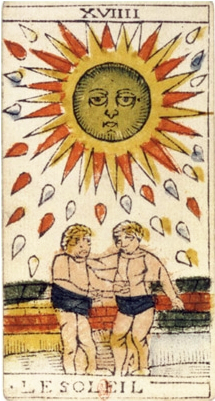
The Marseille card shows a radiant Sun with a human face at the top center, sending rays and drops downward. Below, two figures stand together — children or young people, bare-chested, in a posture of mutual regard. A low wall runs behind them. A garden rather than a wilderness. The atmosphere: warmth, openness, clarity.
The Sun's face distinguishes it from the Moon's profile. Full-face, eyes open. The Moon in XVIII was seen in profile, partially turned away, showing half its features. The contrast is precise: the Moon reveals partially. The Sun reveals completely. Drops falling from the Sun echo the Moon's drops, but where the Moon's suggested moisture — emotion, impression, the fluid medium of the astral — the Sun's suggest warmth and light. The quality of direct knowing.
Tomberg reads the low wall as the threshold between the garden of direct knowledge and the wilderness of the preceding cards. The figures have arrived somewhere. The wall does not confine. It marks the boundary of a cultivated space where direct perception is possible. Mebes reads the two figures' equality of posture as the sign that direct knowledge abolishes hierarchy. In sunlight, there are no masters and students. Only those who see.
Project Role
The Sun names what the project points toward but cannot deliver. The traditions claim direct knowledge — gnosis (CON-0009), unmediated perception of spiritual reality — is possible. The project takes this claim seriously. It presents testimonies of those who say they experienced it: the epoptai at Eleusis, Hermetic practitioners, Christian contemplatives, alchemists who describe the lapis not as a theory but as a perception. But presenting testimony about direct knowledge is itself reflected knowledge. The project operates under the Moon while pointing toward the Sun.
Not a failure. A constitutive limitation — and acknowledging it honestly is more valuable than pretending to transcend it. The project can clear obstructions (the Tower's false constructions), open the listener to reception (the Star's naked receptivity), map the dangers of intermediate territory (the Moon's distortions). What it cannot do is give the listener the Sun's light. That light, if it comes, comes directly. The gap between the project's pointing and the listener's possible seeing is the gap between description and experience. Between the Moon and the Sun. The project's integrity depends on never confusing the two.
Primary Sources
- Tomberg, Meditations on the Tarot, Letter XIX (LIB-0084)
- Mebes, The Course of the Encyclopaedia of Occultism, Arcanum XIX (LIB-0053)
Agent Research Notes
[AGENT: cursor | DATE: 2026-03-25] Scaffolded as part of Tarot Major Arcana KB expansion. Body population pending via prompt relay to Claude Code.